|
|
|
 |
ソフィアート・ガーデン物語 >>前の物語へ >>次の物語へ
■第21話 「小鳥の性格」 2012年5月8日
 若葉が雑木林を覆うようになると、これまで私どもと仲良くしてくれたカラ類たちの営巣も本格化し、私どもの近くには遊びに来てくれなくなります。
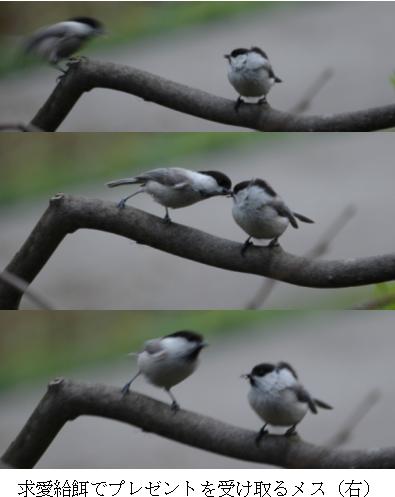
オスはメスに口渡しでおいしい虫をプレゼントし、メスは羽を振るわせて受け取る求愛給餌の様子は>>第8話「小鳥の結婚式」でも書きました。
先日、コガラのメスが枝でぼーっとくつろいでいると、仲良しのツガイのオスがさっとプレゼントを持ってきました。
コガラは体長13センチほどの、卵のように白いかわいい姿で、黒のベレー帽に黒の蝶ネクタイ、グレーの背中と尾羽という、とてもおしゃれな姿です。頭が体に比較して大きく「2頭身」の体型です。
普段の地鳴きは「ビービー、ビービー」という鼻声で甘ったるく、野鳥ではあるものの人なつこいので、初めて見た人はこんなにかわいらしい小鳥が自然界にいるのかと感動すると思います。
 カラ類はそれぞれの「採食空間」があり、木の高いところでヒガラが、中ぐらいでコガラ、低いところでシジュウカラが餌探しをします。(中村登流『森と鳥と』信濃毎日新聞社、1988年)
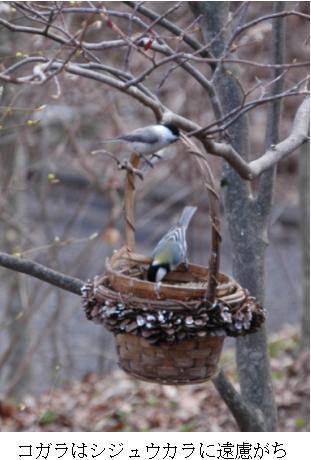
そのため普段は軋轢は生じにくいと思うのですが、冬場に私どもが提供するフィーダーでは、カラ類などが一堂に会するため、序列が生じることになります。
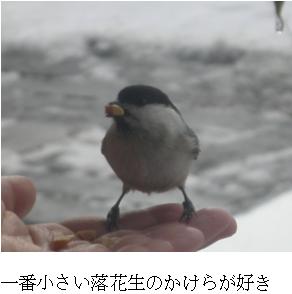
コガラは体が小さいため序列が低く、他の鳥にちょっと遠慮している感じです。私どもの手から落花生を受け取るときはいつも悩んで一番小さいものを受け取ることが多く、それさえも他のカラ類(シジュウカラなど)に追いかけられて奪われることもあります。
実はけっこう頭の良い小鳥で、いつも落花生を奪われるので、私どもの手から小さい落花生を二粒くわえて、それを追ってきたシジュウカラに一粒落として自分の分を確保する、という高等戦術をとります。粗暴な仲間には知能で対抗するわけです。また、ヤマガラ同様に貯食をすることで知られています。
小鳥を眺めていると、人間と同様に、あるいはそれ以上に感情表現が豊かであることに驚かされます。
 あの小さな(しかし体に対してはとても大きい)頭の中で、どのようなことを考えているのかわかりませんが、ひとつ言えることは「生来の楽天家」であろうということです。
何があっても「それは自分たちのために自然がしてくれていること」と解釈する天下一品の能力があります。人間の無造作な振る舞いに対しても、彼らは楽観的に利用します。使えるものは何でも使う、という態度で臨み、自分の都合の良いように解釈する天才です。
たとえば私どもがソフィアート・ガーデンで何かすると、必ず興味津々でチェックしに来ます。スコップなどで土を掘ったり剪定ばさみで枝を払ったりしているときは遠巻きに、私どもがその場を離れれば枝や地面に降りてきて、何か良いものがあるのではないかと細かく点検します。
小屋の工事などで大地を重機で掘り返す際も、休憩時間などには工事現場の道具にちょこんと羽を休めて、なんでもチェック。
人間なら「環境破壊だ!」「工事がうるさい」、などと文句もつけようというところを、野鳥たちは実に楽しそうに、自分たちのためのイベントとして考え、掘られた土から虫を探したり、工事現場の紐にぶら下がってみたり、シュロ縄を毟ってみたり、重機の上をお散歩してみたり・・・。
 台風や荒れた天気の時も、まだ暗雲立ちこめる中に一筋の光を見つけて、いち早くさわやかに鳴き出す小鳥たちの声がすると、人間は遅まきながら嵐が去ったことを知ることが出来ます。小鳥たちの楽天的な声は、厳しい自然の懐で身一つで生きる小さい生きものが待ち望む「希望」の音であります。
また、鳥は常に胸を張り(鳩胸体型のためか)、堂々とした誇らしい姿をしております。
強い個体は羽毛の色つやも美しく、弱い個体はすこし劣る感じもありますが、どんな時にも美しくあろうと羽繕いに余念が無く、歌の練習も怠りなく、高い枝で光を浴びて美声でさえずる姿は、下から見上げる私どもから見れば、ため息がでるほど格好良い存在です。
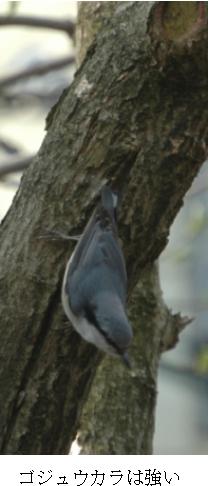 「美しくてかわいい、自信満々で楽天的」、人間なら、なんだか気後れしてしまいそうですが、小鳥であればこれが自然な姿なのです。
とはいえ、小鳥たちにも悲観的な一面があります。私が勝手に自分の感情を彼らに投影しているだけかもしれませんが。
野鳥たちとのつきあいが深くなり、個々の個体を見分けられるようになると、楽天的でいつも強気に見える小鳥たちの間にも、嫉妬や心の葛藤、序列の優劣で強い個体に追われて怖がる姿、もじもじ優柔不断でためらう心などが見て取れます。
>>第5話「小鳥の友情」
こうした弱い個体に対しては、こちらは応援したくなるのが人情というもの。
特にドジを踏んでばかりで、見ていてじれったくなる小鳥には、応援するうちに思い入れも強くなり、その結果さまざまなドラマを観察することにもなります。
以前シジュウカラで、頬の真っ白いはずの羽毛が生まれつき薄汚れた感じで黒っぽいオスがいました。他のシジュウカラより見た目が劣るその個体に「ケン」という名前をつけ、私どもはいつも落花生の小さなかけらをプレゼントしました。
シジュウカラの「ケン」が自分の黒ずんだ頬を足で掻くような仕草をしていると、私も「ケンちゃん、男前!」と褒めて頬を手でこする仕草をまねします。「きれいになるといいね」という願いを込めて。そんな日が何日も過ぎ、落花生の栄養が良かったのか(?)だんだん「ケン」の頬の黒い羽が真っ白の羽毛に生え替わり、背中のモスグリーンとグレーと黒の文様も美しく艶やかになっていきました。
最初は淡い希望と慰めの気持ちで「男前!」と呼んでいたのが、だんだんと真の男前シジュウカラになってしまったのです。
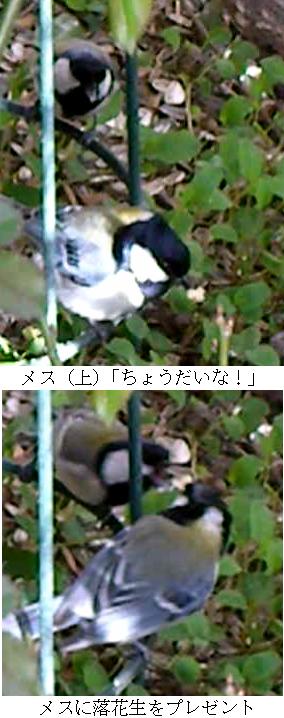 シジュウカラ一般に言えることですが、「ケン」はちょっと性格が暗い感じです。そんな「ケン」でも、落花生のかけらを食べたのがうれしいのか私の前で宙返りしたり、彼なりの精一杯の喜びを表現しているようでした。
シジュウカラで落花生をもらえるのは「ケン」だけでしたので、その特殊能力に惚れ込んで?メスが求愛給餌をもとめて羽を振るわせても、メスにプレゼントするどころか、逃げて隠れて自分だけで落花生を食べる、あまり性格の良くないオスではありましたが。
しかし、押しかけ女房であるメスの熱心なプロポーズでようやく、つがいとなり、甲斐性の無い「ケン」も、私どもの自宅の東にある巣箱で営巣しました。
「ケン」のお相手はなかなか出来たメスで、常に「ケン」を応援する態度でその実はリードし、雛たちが巣立つ頃にはジュウカラの「ケン」も虫をたくさんとってきて雛に懸命に与えるたいそう立派な父親に変身して、無事雛たちは巣立つことができました。その後もこのシジュウカラ夫婦は私どもの東の巣箱の愛用者となり、毎年雛をかえす常連の夫婦となりました。
こんなドラマを毎年のように目にするたび、なんだか人間くさいところも含めて、小鳥たちとのつきあいは楽しくてやめらない、と思うのでした。
『 ソフィアート・ガーデン物語 』 第21話 「小鳥の性格」
有限会社ソフィアート スタッフM( 竺原 みき )
関連する物語
>> 第5話「小鳥の友情」
>> 第22話「小鳥の友情 2」
>> 第27話「小鳥の感情」
>> 第40話「托卵」(ヤマガラのタク)
>> 第86話「小鳥の性格 2」
The Tale of Sophiart Garden
Episode 21: “The Personalities of Little Birds”
May 8, 2012
As the fresh green leaves spread across the grove, the titmice that had been keeping us company grow busy with nesting and no longer come to play around us.
The males court their mates with gifts of tasty insects, delivered beak-to-beak, and the females quiver their wings to receive them?a scene I once wrote about in Episode 8, “The Wedding of the Little Birds.”
The other day, I saw a female willow tit relaxing dreamily on a branch when her devoted partner suddenly appeared with a gift. The willow tit is a tiny bird, about 13 centimeters long, with the white roundness of an egg, a stylish black beret and bow tie, and soft gray plumage across its back and tail. Its head looks large in proportion to its body?rather like a “two-head-tall” cartoon figure.
Its everyday call is a sweet, nasal “bee-bee, bee-bee,” endearingly plaintive. Despite being a wild bird, it is so friendly and charming that anyone seeing it for the first time would be astonished to discover such a creature existing in the natural world.
Each species of titmouse has its own foraging “space.” The coal tit prefers the higher branches, the willow tit the middle levels, and the great tit the lower ones. (Nakamura Toru, Mori to Tori to [The Forest and the Birds], Shinano Mainichi Shimbun, 1988).
Ordinarily, this prevents conflict, but in winter, when they all gather at the feeders we provide, a pecking order inevitably emerges.
Because willow tits are small, their rank is low. They often appear hesitant, choosing the tiniest peanut from our hands, and even then, they are chased down and robbed by other titmice.
Yet they are remarkably clever. Tired of losing their prize, one devised a brilliant tactic: taking two small peanuts from my hand, then deliberately dropping one when pursued by a great tit, distracting the bully and keeping the other for itself. With intelligence, they counter the brutishness of their peers. Like the varied tit, they are also known for caching food.
Watching these little birds, one is struck by how vividly they express emotion?sometimes even more so than humans.
What exactly goes on inside that tiny (yet disproportionately large) head, I cannot say. But one thing is certain: they are born optimists.
Whatever happens, they seem to interpret it as something nature has kindly arranged for their sake. Even human carelessness, they cleverly turn to their advantage. Their philosophy seems to be: use whatever can be used, and interpret it always in the most convenient light.
For instance, whenever we do anything in Sophiart Garden, they arrive, full of curiosity, to inspect it. If we are digging with a spade or pruning with shears, they keep their distance, but the moment we step away, they swoop down to investigate, certain that some good thing awaits.
Even when heavy machinery tears open the earth for a shed foundation, during breaks they perch lightly on the tools, busily checking everything.
Where humans might cry “Environmental destruction!” or complain of the noise, the wild birds seem delighted?as if the whole thing were an event staged for them. They search the freshly turned soil for insects, dangle from construction cords, tug at palm-fiber ropes, even stroll about atop the bulldozers.
During typhoons or wild weather, when dark clouds still linger, it is the little birds who first notice the single shaft of light breaking through, greeting it with fresh song. Only then do we humans, belatedly, realize the storm has passed. Their cheerful voices are the very sound of “hope”?the voice of small beings who live with nothing but themselves to rely on in the harsh embrace of nature.
And they always carry themselves proudly, breast thrust out (perhaps because of their pigeon-chested build), exuding dignity.
The strong individuals shine with sleek, vibrant plumage; the weaker ones appear somewhat duller. Yet even they never cease preening, striving always to be beautiful, nor do they neglect their song practice. Perched high in the branches, bathed in sunlight, they pour forth their voices?so splendid from below that one cannot help but sigh in admiration.
Beautiful, adorable, self-assured, and ever optimistic?were these human traits, we might feel intimidated. But in a little bird, this is simply its natural state.
That said, birds do have their more pessimistic sides?though perhaps I am merely projecting my own emotions onto them.
As one grows closer to the wild birds, learning to recognize individuals, one begins to see that even the bold and optimistic among them sometimes reveal jealousy, inner conflict, fear when pursued by stronger rivals, hesitation, indecision, or shyness. (See Episode 5, “The Friendship of Little Birds”).
Toward the weaker ones, it is only natural for us to feel like cheering them on. Especially the clumsy, awkward little birds?so exasperating, yet so endearing?that we cannot help but grow attached, and in following their struggles, we witness all kinds of small dramas unfold.
Once there was a male great tit whose cheeks, normally pure white, were blotched and dingy from birth. Because he looked plainer than the others, we gave him the name Ken and always slipped him a little piece of peanut.
When Ken scratched at his darkened cheeks with his foot, I would mimic him with my hand, saying, “Ken-chan, you handsome fellow!”?as if wishing his cheeks might become clean. Days passed, and perhaps thanks to the nutrition of peanuts, the black feathers gave way to gleaming white, and the moss-green, gray, and black patterns on his back grew glossy and striking.
At first, I called him “handsome” as a gentle consolation, but before long, he truly had become a handsome great tit.
Like great tits in general, Ken seemed to have a somewhat gloomy temperament. And yet, when he received a peanut, he would sometimes turn a somersault before me, as if expressing joy in the only way he could.
No other great tit besides Ken was given peanuts, and perhaps it was this special talent that attracted a female. But when she fluttered her wings in a request for courtship feeding, Ken, instead of offering a gift, would dash off to eat the peanut all by himself?not the kindest of suitors.
Still, thanks to the persistent devotion of this “pushy bride,” Ken finally formed a pair. Though lacking in initiative, he began nesting with her in the box east of our house.
She was an admirable mate?always encouraging Ken while quietly leading the way. By the time their chicks were ready to fledge, Ken too had transformed into a fine father, tirelessly bringing insects to feed them. Their chicks safely left the nest, and ever since, this pair of great tits has returned each year to raise their brood in that same box.
Each time I witness such dramas, I realize once more: it is precisely because of their human-like qualities, endearing flaws and all, that my life with the little birds is so joyous?and so impossible to give up.
|
| |
| |